Mini Antistress Relaxing Games
stick hunterCasual
4.2382.00 Reviews
- Version
- 2.9
- Installs
- 10.00M
- Age Rating
- Everyone 10+
Screenshots
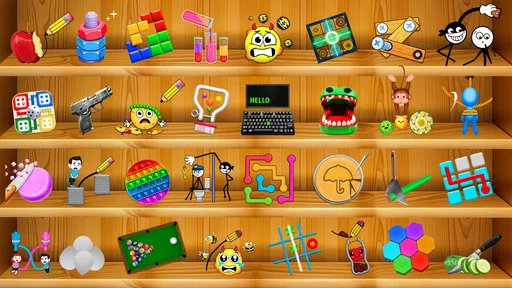
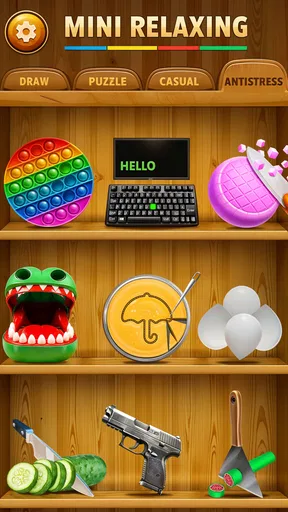
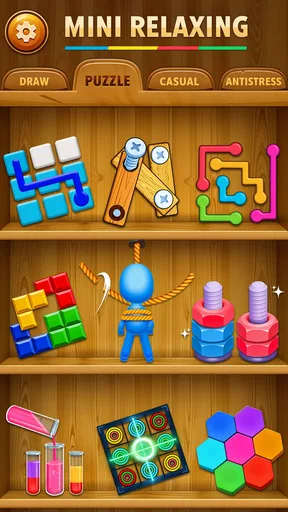
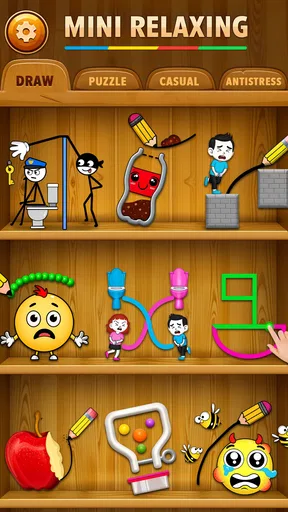
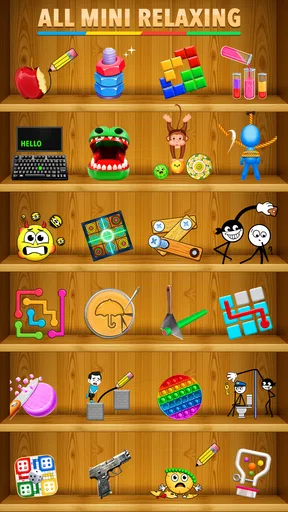
Our Review of Mini Antistress Relaxing Games
 Analysis by Appyee
I approached Mini Antistress Relaxing Games expecting a handful of simple distractions, and that is exactly where its appeal lies. This is a casual game from stick hunter that focuses on brief, low-pressure play rather than a long campaign, competitive progression, or a demanding challenge. After spending time with it, my main conclusion is straightforward: it works best as a small reset button for restless moments, not as a complete replacement for a deeper puzzle game, meditation app, or full entertainment session.
The idea is easy to understand. You open the game, choose something calming to do, and spend a few minutes letting your attention settle on simple interactions. That makes it a natural fit for a commute, a short break between tasks, or the few minutes before bed when I want something more engaging than staring at a blank screen but less stimulating than social media. Its store summary presents it as a way to unwind and ease stress, and in my experience that description is most convincing when the game is used in small portions.
What the game gets right about short, calming play
The strongest part of the experience is its low commitment. I do not need to remember a complicated story, prepare a strategy, or worry about losing progress after stepping away. That matters because an antistress game can defeat its own purpose if it constantly asks me to perform, optimize, or compete. Here, the casual format makes it possible to start playing with almost no mental preparation.
I also like the way this kind of collection can match different moods. Sometimes I want a repetitive activity that occupies my hands. At other times, I want a tiny diversion that gives my mind a clear object to focus on for a moment. A group of mini-games is more useful for that than one narrowly defined activity because I can change direction when a particular interaction stops feeling relaxing.
That flexibility is especially useful during an ordinary workday. Imagine finishing a difficult email, feeling mentally scattered, and having five minutes before the next appointment. A large game would be too much of a commitment, while a video feed could easily turn five minutes into half an hour. I found this type of short session easier to control: play briefly, let the mind shift gears, and close the app without feeling that I have abandoned a larger objective.
The game’s casual classification is important here. It signals the right expectation: this is designed around accessibility and immediate play, not mastery. I would not install it looking for a carefully balanced challenge or a substantial narrative. I would install it because I want something uncomplicated that can fill a small gap without demanding much from me.
Its broad reach supports that role. The game has passed 10 million installs, and its average rating is 4.2. Those figures do not prove that every player will find it soothing, but they do suggest that the basic concept has connected with a large audience. I can understand why: the entry barrier is low, the purpose is immediately clear, and the format suits people who do not usually spend time with traditional games.
Why the mini-game format is more useful than it first appears
A subtle strength is that short activities can serve as a transition between mental states. I found the game more helpful when I treated it as a ritual rather than as entertainment I had to consume for a long stretch. Opening it after work, playing until I felt less keyed up, and then putting the phone down gave the session a clear beginning and end. That is different from endlessly scrolling, where there is rarely a natural stopping point.
Another practical advantage is that the game does not require me to be “good” at it for the session to feel worthwhile. In many casual titles, failure is softened but still tied to goals, rewards, or a desire to improve. With a relaxing collection, the value can come from the interaction itself. That makes it suitable for players who normally avoid games because they associate them with pressure or competition.
I would still recommend changing activities instead of forcing one that irritates you. If a particular mini-game feels repetitive or awkward, moving to another option is a better use of the format than trying to extract enjoyment from it. The collection works because it gives the player room to choose, not because every activity will suit every personality.
For that reason, I would use it differently from a puzzle title. With a puzzle game, I might sit down intending to solve a set of problems. With this one, I would decide how I feel first. If I am overstimulated, I would choose the simplest interaction available. If I am bored but not especially tense, I might spend longer exploring the selection. That mood-based approach is one of the most practical ways to get value from it.
A good companion for specific daily routines
The best everyday use case I found was the “in-between” moment: waiting for an appointment, taking a short break from study, or sitting on public transport without wanting to consume news. These moments are long enough to invite distraction but too short for a conventional game. Mini Antistress fits them because I can begin without building momentum and stop without losing a meaningful run.
It can also work as a screen-based alternative to fidgeting, although I would be careful not to present it as treatment for anxiety or a substitute for professional support. A calming game may help me redirect attention temporarily, but serious or persistent distress needs more than an app. The most honest way to view this title is as a small coping aid for ordinary tension, not a medical solution.
Parents and younger players should also pay attention to the age classification. It is marked Everyone 10+, so I would not assume that it is intended for very young children simply because the gameplay is casual and calming. The rating is a useful reminder to check the experience personally before handing it to a child, particularly if the device is shared.
Where the experience loses some of its calm
The main weakness is the same feature that makes the game approachable: simplicity. If I want a richer sense of progression, a strong story, or a challenge that grows with my ability, this collection may feel shallow. The activities are better understood as brief exercises in attention than as a game I would commit to mastering over weeks.
That distinction matters because the word “relaxing” can mean different things. Some players relax through repetition, while others relax by becoming absorbed in a demanding task. This game is aimed much more at the first group. If solving increasingly intricate puzzles helps you unwind, a dedicated puzzle game may be more satisfying. If you prefer guided breathing, ambient sound, or structured mindfulness, a meditation app will probably be a better match.
I also noticed a potential tension between the calming purpose and the commercial design of a free mobile game. Mini Antistress is free to download, but in-app purchases range from $2.49 to $12.99 per item. That does not automatically make the experience unsuitable, yet it means I would approach the purchase options deliberately. A relaxation tool should not make me feel hurried into spending, so I would use the free experience first and decide later whether any optional purchase genuinely improves my routine.
This is one of the most important practical trade-offs. Free access makes the game easy to try, but the presence of optional purchases can affect how comfortable the experience feels for different people. For a child’s device, I would be especially cautious about purchase controls. For my own phone, I would simply avoid buying anything until I knew I would return to the game regularly.
Another limitation is that a collection of mini-games can encourage sampling without creating a lasting habit. I may open it, try several activities, and then move on because none becomes a personal favorite. That is not necessarily a design failure; the app is built for casual use. Still, anyone looking for a dependable daily practice might prefer an app with saved routines, scheduled sessions, or a clearer long-term structure.
How I would use it without turning relaxation into another task
My first tip is to set a natural boundary before opening it. I would decide that the session is for a short reset, not for unlocking everything or proving that I can stay calm. This prevents the familiar mobile-game habit of continuing simply because another activity is available. The game is most effective when I remain in control of the stopping point.
My second tip is to separate “distraction” from “recovery.” If I am merely bored, the game can fill time. If I am genuinely exhausted, more screen interaction may not help as much as putting the phone away, stretching, or resting my eyes. I would choose Mini Antistress when I need a gentle change of focus, not automatically whenever I feel uncomfortable.
My third tip is to use it before a demanding transition rather than after stress has peaked. A few minutes before a presentation, study session, or difficult conversation may help me move away from scattered thoughts. It cannot guarantee calm, but the simple routine can be easier to repeat than an elaborate self-care plan. The key is to keep expectations modest and use the app as one small part of a broader routine.
I would also avoid judging the game by a single session. Relaxation is personal, and an activity that feels soothing one evening may feel irritating the next. If the interactions make me more restless, I would stop rather than assume I need to play longer. That is a meaningful test for this category: the app should feel optional and easy to leave.
Who should download it and who should look elsewhere
I think Mini Antistress is a good choice for someone who wants quick, uncomplicated diversions and does not usually identify as a gamer. It is particularly suitable for people who enjoy tactile repetition, have short breaks during the day, or want an alternative to endlessly refreshing social feeds. The low-pressure format also makes it approachable for casual players who dislike leaderboards, complex controls, and long tutorials.
It may suit students who need a brief reset between study blocks, office workers who want to clear their head after a tense task, and travelers who need something quiet while waiting. I would also consider it for someone trying to build a short “phone down afterward” routine, provided they are willing to close the app instead of drifting into other content.
I would skip it if I am specifically searching for a deep game. Players who want character development, strategic decision-making, competitive systems, or a substantial sense of achievement will likely outgrow it quickly. I would also look elsewhere if my priority is guided mental-health support, sleep instruction, or clinically oriented anxiety management. The calming theme is useful, but the experience remains a casual game.
The current version is 2.9, and it runs on devices using Android 7.0 or later. That makes it accessible to people who keep older Android phones, although device age can still affect how pleasant any touch-based game feels. Before installing, I would make sure the phone has enough free space for normal app operation and that its screen responds reliably; small, simple interactions are not enjoyable when taps are missed.
It is also worth remembering that the developer is listed as stick hunter. I would use that information when deciding whether to explore the developer’s other titles, but I would judge this game on its own purpose. A casual antistress collection does not need the same qualities as an action game, and comparing it directly with a completely different genre can create unfair expectations.
My verdict after using it as a short reset
Mini Antistress Relaxing Games succeeds when I treat it as a pocket-sized pause rather than a major gaming destination. Its strongest qualities are immediate access, a gentle casual identity, and enough variety to let me choose an activity that matches my mood. The format makes sense for short breaks, especially when I want something more active than passive scrolling but less demanding than a conventional game.
Its limitations are equally clear. The simplicity may feel thin for players who need depth, and the optional purchases mean I would approach the free-to-play model carefully. It also should not be mistaken for therapy, a meditation course, or a guaranteed answer to serious anxiety. Those boundaries do not ruin the experience; they simply define where it belongs.
With over 132 thousand ratings and more than 382 thousand written reviews, the game has attracted substantial attention, but popularity is not the deciding factor for me. The real question is whether I want a small collection of calming interactions that I can open and leave easily. If the answer is yes, this is a sensible free download to try, with purchases treated as optional rather than necessary.
My recommendation is therefore specific: choose it for brief, low-pressure resets and everyday moments when your hands need something simple to do. Skip it if you want a long-term challenge, structured mindfulness, or a rich game world. Used within its limits, it is a pleasant casual companion, and its best feature is the freedom to stop before relaxation becomes another obligation.
Verdict
Strengths of Mini Antistress Relaxing Games
- Quick mini-games are ideal for short breaks or stress-relief sessions.
- Simple controls make the collection accessible to most players.
- The variety of activities helps prevent the experience from feeling repetitive.
- Offline play makes it useful during travel or without a stable connection.
- Relaxing gameplay requires little concentration or gaming experience.
Limitations of Mini Antistress Relaxing Games
- Some mini-games may feel too simplistic for players seeking deeper challenges.
- Repeated activities can become monotonous after extended play sessions.
- Certain features or content may be limited without in-app purchases.
- The relaxing experience may be interrupted by advertisements.
- It offers little progression or long-term motivation beyond casual play.
Other Releases by stick hunter
View All
Tricky Relax Challenge Games
Casual4.1

ASMR Makeover: Skincare Games
Casual0.0
Similar Picks in This Category
View All
My Talking Angela
Outfit7 Limited4.2

My Talking Tom
Outfit7 Limited4.3

Pou
Zakeh4.2

My Talking Tom 2: Pet Game
Outfit7 Limited4.3

Candy Crush Saga
King4.6

Bridge Race
Supersonic Studios LTD4.1
Frequently Asked Questions
What is Mini Antistress Relaxing Games?
Mini Antistress Relaxing Games is a casual collection of small, calming activities designed for short breaks and stress relief. Instead of focusing on difficult challenges or competitive gameplay, it offers simple interactions such as tapping, swiping, sorting, and other relaxing exercises. The experience is easy to understand, making it suitable for players who want a quiet distraction without a complicated tutorial or demanding time commitment.
Is Mini Antistress Relaxing Games free to download and play?
The app can generally be downloaded for free, allowing users to try its selection of relaxing mini-games without paying at the beginning. However, availability of certain activities, extra content, advertisements, or optional purchases may depend on the version installed and the device platform. Before downloading, it is worth checking the store listing for current in-app purchase details and whether the free version includes all features.
Does the app work without an internet connection?
Many of the mini-games are designed for quick, independent play and may work without a constant internet connection once the application has been installed. This makes the app convenient for travel, waiting rooms, or moments when mobile data is unavailable. Some features, advertisements, updates, analytics, or purchases may still require internet access, so offline functionality can vary depending on the specific game and app version.
Is Mini Antistress Relaxing Games suitable for children?
The simple controls and non-violent, low-pressure gameplay can make Mini Antistress Relaxing Games appealing to children as well as adults. Nevertheless, parents should review the app’s age rating, advertising, privacy information, and possible in-app purchases before allowing unsupervised use. Some activities may be harmless and relaxing, but screen-time limits and device purchase restrictions are still recommended for younger players.
Are there any disadvantages to using Mini Antistress Relaxing Games?
The main limitation is that the experience is intentionally simple, so users looking for a deep story, advanced progression system, or challenging gameplay may find it repetitive after extended sessions. Free versions may also contain advertisements or restrict some content. In addition, the relaxing effect is subjective: short sessions can be useful for distraction, but the app should not be considered a replacement for professional support when dealing with serious stress or anxiety.
Play our best games!


